Views: 0 Author: Site Editor Publish Time: 2026-07-24 Origin: Site


Ordering the wrong replacement belt brings serious operational consequences. You face extended machine downtime, ruined glass edges, and premature belt failure. Abrasive glass dust and constant water exposure destroy incorrect materials quickly. Glass processing environments act like continuous sandpaper against standard mechanical components. We created this guide as a technical pre-purchase checklist. Maintenance managers and procurement teams can use it to evaluate replacements or upgrades effectively.
Identifying the correct glass machine timing belt requires deeper inspection. You must look beyond standard dimensions to assess coatings, tensile cords, and joint types. Selecting the proper components ensures smoother operation and prevents catastrophic line stops. You will learn how to verify specifications, choose backing materials, and avoid common ordering mistakes.
Standard industrial belts fail rapidly in glass processing; specialized coatings (e.g., Linatex, PU) are required to balance grip and abrasion resistance.
Core material selection (Steel vs. Kevlar) must account for the high-moisture environment of glass edging and beveling machines.
Thermally spliced belts offer lower upfront costs, but truly endless belts provide superior tensile strength for heavy-load glass transmission.
Accurate pitch, tooth profile, and Shore hardness verifications are non-negotiable before issuing a PO.
Glass processing environments present incredibly harsh conditions. Edging and beveling machines handle continuous water coolant sprays. Abrasive glass swarf builds up rapidly across all moving parts. Heavy lateral loads stress the equipment as grinding wheels push against thick glass panels. These unique stressors demand highly robust mechanical solutions. Standard factory components simply cannot survive here.
If you install a generic industrial timing belt, expect rapid degradation. Standard polyurethane compounds swell or slip under wet conditions. Generic rubber tears easily when exposed to sharp glass fragments. You need a dedicated glass transmission belt designed specifically for this wet, abrasive environment. Specialized components feature moisture-resistant jackets and reinforced backings to handle lateral pressure without deforming.
A successful replacement must meet strict operational criteria. The new belt must achieve exact synchronous conveying to prevent panels from rotating out of alignment. It must prevent glass scratching during high-speed transport. Finally, it must resist moisture-induced delamination. Delamination occurs when water penetrates the backing layers, causing them to peel away. Proper material selection prevents this catastrophic failure.
Getting the dimensions wrong ruins tracking immediately. Glass machinery relies on highly specific tooth profiles to transfer power efficiently. The most common profiles include T10, AT10, and H types. These profiles dictate how the teeth mesh into the drive pulleys. If you lack the original equipment manufacturer manual, you must measure the pitch manually. Pitch represents the exact distance between the centers of two adjacent teeth. Use a high-quality digital caliper for precise readings.
Below is a quick reference chart for common tooth profiles used in glass facilities:
Profile Type | Pitch Distance (mm) | Tooth Shape | Common Glass Application |
|---|---|---|---|
T10 | 10.0 | Trapezoidal | General glass conveying and washing |
AT10 | 10.0 | Reinforced Trapezoidal | High-tension beveling and edging |
H | 12.7 (0.5 inch) | Standard Imperial | Heavy-duty architectural glass lines |
Width and length tolerances require strict attention during the ordering phase. Acceptable tolerances usually fall within tiny fractions of a millimeter. If width measurements are off by even one millimeter, tracking issues arise. The belt rubs against the pulley flange continuously. This friction causes rapid edge wear and potential snapping under load.
We recommend a specific verification tip to avoid common ordering errors. Always count the teeth manually instead of just measuring total length. Then, measure the overall length while the system remains under tension. Old materials stretch over time. Ordering a replacement based on a stretched, worn measurement guarantees an inaccurate fit.
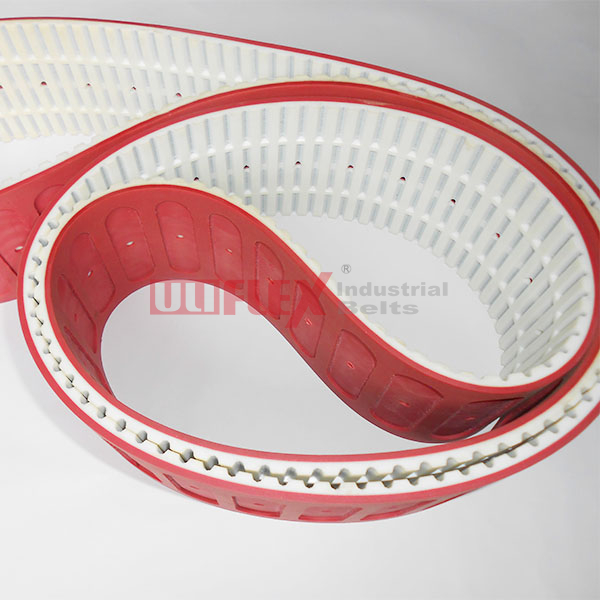
The base structure drives the machinery, but the backing material touches the glass directly. This coating performs a critical function. It must provide enough friction to hold heavy panels firmly against the grinding wheels. However, it cannot scratch delicate surfaces or leave permanent marks. Balancing grip and softness defines a quality coating.
Choosing between materials depends entirely on the processing stage. A PU timing belt for glass machine applications offers exceptional wear resistance. It handles sharp, unpolished edges extremely well without tearing. Conversely, Linatex or Red Rubber provides superior wet grip. Natural rubber features a softer Shore hardness. This makes it ideal for preventing surface marks on finished panels.
Sometimes, standard flat backings fall short of operational needs. A custom coated PU belt solves specific tracking challenges. Manufacturers can route or groove these backings. Machined grooves match specific glass thicknesses and machine tracks perfectly. This customization prevents lateral shifting during heavy grinding stages.
Use the following decision matrix to match your coating to the application:
Processing Stage | Recommended Backing | Typical Shore Hardness | Key Operational Benefit |
|---|---|---|---|
Rough Edging | Standard Polyurethane (PU) | 85A - 90A | Resists severe cuts from raw glass |
Wet Beveling | Linatex / Red Rubber | 35A - 45A | Extreme grip under heavy water flow |
Final Washing/Drying | Foam / Soft PU Blend | 45A - 60A | Zero surface scratching on clear glass |
The inner tensile cord acts as the system's spine. It dictates the total load capacity. It also determines stretch resistance over thousands of operating hours. Choosing the wrong cord leads to sudden snapping and dangerous equipment failures.
Steel cords offer distinct mechanical advantages. They boast the highest tensile strength available. They exhibit practically zero stretch under heavy loads. However, steel carries major drawbacks in wet environments. Constant water exposure poses a severe rust risk. If sharp glass fragments compromise the outer jacket, water reaches the steel directly. The cord rusts quickly, weakens internally, and eventually snaps under tension.
Kevlar or Aramid cords provide a strong alternative for wet processing. They are highly flexible around small pulleys. More importantly, they remain completely corrosion-proof in wet conditions. Even if the jacket tears, water will not degrade the Kevlar fibers. The main drawback is a slightly lower absolute load capacity compared to steel. Kevlar also experiences a minor break-in stretch during the first few days of operation.
To mitigate risk, inspect your current setup thoroughly. Look closely at the old component's failure mode. Did it snap due to internal rust? If so, switch to Kevlar immediately. Did it stretch out and jump teeth? Steel might be the better choice if you can improve your machine's water shielding capabilities.
Manufacturers produce thermally spliced belts from long, open-end rolls. Technicians cut the roll to length and weld the ends together using extreme heat. This thermal weld creates a continuous loop. These spliced options offer lower upfront expenses. However, the splice area drops the overall tensile strength by roughly fifty percent. They perform best in lighter conveying tasks. You should only use them for lower-tension applications where sudden jamming remains unlikely.
Truly endless belts undergo a completely different manufacturing process. Factories extrude them without any seams. They form a continuous, unbroken structure from day one. These flex belts are mandatory for heavy, high-torque glass processing belt applications. They prevent sudden joint failure under immense loads. High-speed double-edging machines require truly endless construction to maintain synchronized speed on both sides.
Consider the lifespan impact before choosing a joint style. Endless options require a higher initial investment. Yet, they significantly reduce replacement frequency. They also minimize unexpected maintenance downtime. Fewer mid-shift replacements keep your production lines running efficiently and protect your bottom line.
Do not rush the purchasing process. Treat the ordering phase as a strict technical audit. Following a systematic approach prevents costly returns and operational delays.
Here is the final pre-order verification list:
Document the exact OEM Part Number and Machine Model (e.g., Bavelloni, Bottero, Schiatti).
Verify all exact dimensions, including tooth profile, pitch, width, total length, and the exact number of teeth.
Specify the required backing material and its precise coating thickness in millimeters.
Choose the correct inner cord material (Steel or Kevlar) based on moisture exposure.
State your joint preference clearly (Thermally Spliced or Truly Endless).
Vetting your supplier is equally critical. You must ensure they understand the nuances of glass manufacturing. Ask distributors specific technical questions:
Inquire about their current lead times for custom grooving and backing application.
Check if they handle in-house coating capabilities or if they outsource the work to third parties.
Request quality assurance data specifically detailing their thermal splice strength.
Avoid suppliers who dodge technical questions. If they cannot provide specification sheets outlining the coating's exact Shore hardness, find another partner. Reliable manufacturers gladly supply engineering data to back up their products.
Treating a replacement component as a generic commodity harms operational efficiency and causes financial waste. Overlooking specialized coatings or incorrect cord materials guarantees premature equipment failures. Proper technical specification prevents ruined glass panels and halts chronic machine downtime. By matching the backing material to your specific process, you ensure optimal edge quality.
We encourage procurement teams to collaborate deeply with maintenance staff before placing an order. Always verify the exact failure mode of the old part first. Do not simply order the exact same specification blindly. Upgrading your surface coating or switching to a corrosion-proof cord material often solves persistent mechanical issues.
Take action before your next scheduled maintenance cycle. Consult a technical specialist about your current machine environment. Submit your precise machine specifications to a trusted manufacturer to secure a highly customized solution today.
A: Lifespan depends heavily on shift volumes, proper tensioning, and machine maintenance. Constant exposure to poorly maintained water lines degrades materials faster. Focus on identifying premature wear patterns rather than tracking exact operating hours. A well-maintained setup should run for several months of continuous multi-shift production before requiring replacement.
A: Marks usually indicate an incorrect coating selection. The Shore hardness of your backing is likely too high for the glass type. Alternatively, abrasive glass dust may have embedded itself into a degraded rubber backing. Switching to a softer, specialized PU coating prevents these surface scratches and preserves edge quality.
A: We strongly advise against replacing just one side. Old belts stretch and wear down over time. Pairing a new belt with an old one causes uneven tracking. This mismatch creates lateral forces that ruin delicate glass edges. Always replace dual-track systems in matched pairs to ensure perfect synchronization.
A: Inspect the entire length of the back and tooth side. A thermally spliced belt will show a distinct zig-zag or straight visual line where the ends were welded together. You can often feel a slight textural difference or stiffness at this seam. Truly endless belts look and feel completely uniform throughout their entire length.