Views: 0 Author: Site Editor Publish Time: 2026-08-15 Origin: Site


In high-speed positioning, robotics, and precision linear motion, micro-variations matter immensely. Tiny fluctuations in component pitch cause severe mechanical backlash. They trigger system resonance and create cumulative positioning errors over long travel distances. Standard spliced solutions often introduce structural weak points directly at the physical joint. Truly continuous manufacturing eliminates this splice entirely. This fundamentally changes the drive's mechanical consistency. We wrote this comprehensive guide to help you evaluate your motion control options. It provides engineers and procurement teams a strict evaluation framework. You will learn exactly how to determine if and when to specify a polyurethane endless timing belt over spliced or traditional rubber alternatives. We explore core materials, tension members, and necessary system tolerances in detail. You gain the practical insights needed to ensure your automated systems achieve the exact repeatability your demanding applications require.
Uniform Tensile Strength: "Truly endless" manufacturing eliminates the stiffness variations found in spliced/welded joints, preventing localized pitch errors.
Tooth Rigidity: Polyurethane offers higher shear strength than rubber, preventing tooth deformation under sudden high-torque loads.
Cord Selection Dictates Performance: The choice between a steel cord timing belt and a Kevlar cord timing belt directly impacts elongation limits and minimum pulley diameter requirements.
System Dependencies: Upgrading to a precision timing belt yields zero ROI if pulley tolerances, alignment, and initial pre-tensioning are sub-standard.
Welded or spliced belts feature a visible joint. Manufacturers severe the internal tension cords here to bond the open ends together. This creates a localized area exhibiting severely reduced tensile strength. Flexibility changes drastically exactly at the weld line. When this rigid joint passes over drive pulleys, the stiffness variation disrupts smooth rotational motion.
You observe these disruptions as micro-fluctuations in shaft velocity. Over time, the welded splice becomes a primary failure point under heavy cyclic loading. The melted polyurethane holding the joint stretches slightly under peak torque. This stretch alters the tooth pitch locally. Continuous loop constructions bypass this structural flaw entirely, offering unbroken strength.
In an endless PU timing belt, the manufacturing process differs entirely from open-ended extrusion. Machines helically wind the tension members continuously during the urethane casting or extrusion phase. We see a mathematically uniform pitch line across the entire circumference. There are no cord interruptions or sudden changes in cross-sectional density.
The tooth spacing remains absolutely identical from the first millimeter to the last. This strict dimensional uniformity guarantees synchronous power transmission without periodic pitch errors. Actuators rely on this exact tooth spacing to translate rotational motor steps into precise linear distances perfectly.
Eliminating the physical splice removes the mechanical vibration spike completely. Engineers often call this disturbance the "hiccup" effect. It happens every time a welded joint wraps around a small pulley. A continuous construction directly improves mechanical repeatability. You notice this improvement immediately when tuning automated linear actuators.
CNC axes benefit greatly from this uninterrupted stability. We eliminate the localized stretching occurring at the joint, keeping the driven load perfectly synchronized. The motor encoder reads exact positions without compensating for mechanical slop. This creates smoother surface finishes in machining and faster settling times in pick-and-place robotics.
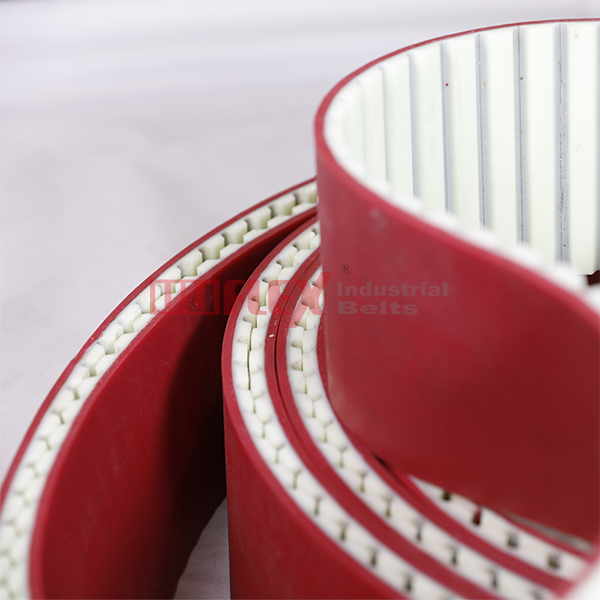
Polyurethane is significantly harder than standard neoprene or rubber compounds. Under rapid acceleration or rapid deceleration, PU teeth actively resist compression. They prevent structural deflection, effectively minimizing mechanical backlash. This rigidity ensures exact positioning during aggressive move profiles.
When a servo motor reverses direction rapidly, rubber teeth squish and deform temporarily. This deformation absorbs motion, causing the load to lag behind the motor. PU teeth hold their shape rigidly. The load moves the exact moment the pulley rotates, ensuring synchronous movement.
PU does not swell easily. It resists chemical degradation when exposed to common industrial oils, synthetic lubricants, or greases. Harsh factory environments destroy standard rubber quickly. UV light and ozone exposure do not break down high-grade polyurethane easily. You maintain strict dimensional tolerances over the entire component lifecycle.
This chemical resistance prevents the profile from losing tension or softening over time. Standard rubber absorbs ambient machine oils, causing the pitch diameter to swell. Swollen teeth grind against pulley flanges and accelerate drive failure. Polyurethane prevents this volumetric expansion entirely.
Standard rubber degrades through surface friction. It sheds fine black carbon dust constantly during normal operation. Polyurethane remains inherently clean and resists abrasive wear. This non-shedding characteristic represents a non-negotiable compliance factor for modern ISO-rated cleanrooms.
Optical equipment manufacturing lines require zero airborne particulates. Food processing facilities demand clean, non-toxic power transmission solutions. A synchronous belt cast from pristine PU meets these strict environmental requirements perfectly. You eliminate the need for secondary dust containment enclosures.
We must address the thermal boundaries accurately. PU generally exhibits lower maximum operating temperatures than rubber. They typically handle continuous ambient heat around 80°C (176°F). Extreme friction or high-speed operation in enclosed spaces pushes internal temperatures higher.
Specialized rubber compounds endure much higher heat profiles without melting or degrading. If your application involves intense ambient heat, polyurethane might soften and skip teeth. You must audit ambient temperatures and airflow before specifying this material for high-heat industrial ovens or combustion environments.
Material Attribute | Polyurethane (PU) | Standard Neoprene (Rubber) |
|---|---|---|
Tooth Shear Strength | Excellent (High Rigidity) | Moderate (Compresses under load) |
Particulate Shedding | Zero to Low (Cleanroom safe) | High (Sheds carbon dust) |
Oil & Grease Resistance | Outstanding (No swelling) | Poor (Swells and weakens) |
Maximum Temperature | Approx. 80°C (176°F) | Approx. 100°C+ (212°F+) |
Dimensional Stability | Superior (Maintains exact pitch) | Variable (Stretches over time) |
A steel cord timing belt represents the industry standard for maximum rigidity. Manufacturers embed fine, high-tensile steel cables inside the urethane jacket. They offer the highest tensile modulus available. You experience near-zero elongation over time. The metal core prevents gradual stretching entirely.
We specify these cords for heavy load lifting and vertical z-axis drives. They excel in long-span linear applications requiring extreme rigidity. However, you must observe strict limitations. Steel requires larger minimum pulley diameters. Tight bends cause metal fatigue and cord snapping. They remain susceptible to internal corrosion if the outer PU jacket tears.
A Kevlar cord timing belt provides an alternative for specific engineering constraints. Kevlar provides exceptional flexibility compared to steel. You get a remarkably high strength-to-weight ratio. The aramid material remains entirely non-magnetic, offering unique advantages.
We use Kevlar in compact drives utilizing very small pulleys. Environments requiring sudden shock absorption benefit from Kevlar's slight dampening properties. MRI machines and sensitive medical equipment require non-magnetic components. Limitations exist, though. They exhibit slightly higher stretch under the initial dynamic load. Kevlar fibers also wick moisture if exposed.
Selection Criteria | Steel Cords | Kevlar (Aramid) Cords |
|---|---|---|
Flexibility / Bending Radius | Low (Requires larger pulleys) | High (Allows smaller pulleys) |
Elongation Rate | Near Zero (Maximum rigidity) | Slightly higher initial stretch |
Weight | Heavy | Lightweight |
Magnetic Interference | Magnetic (Not for MRI use) | Non-Magnetic (Medical safe) |
Shock Load Tolerance | Poor (Can snap under extreme shock) | Excellent (Absorbs sudden impacts) |
A precision timing belt cannot compensate for cheap hardware. Out-of-round pulleys destroy your positioning accuracy immediately. System precision always matches your lowest-quality component. If a pulley exhibits runout errors, the driven load will oscillate predictably during every rotation.
You must machine or purchase pulleys featuring runout tolerances matching your exact specification. Flange angles must remain perfectly perpendicular. A continuous pitch line means nothing if the aluminum pulley varies in diameter by several thousandths of an inch. Invest equally in the drive hardware.
Endless loops require exact initial tensioning. You cannot guess the tension by pressing it manually. We recommend using calibrated sonic tension meters to measure the exact resonant frequency. Proper tensioning prevents excessive wear and maximizes transmission accuracy.
Determine the target vibration frequency using manufacturer data tables based on span length and mass.
Mount the endless loop carefully and apply preliminary tension through the adjustable idler pulley.
Pluck the unsupported span lightly to generate a sound wave.
Record the hertz reading using a calibrated sonic tension meter.
Adjust the center distance incrementally until the measured reading matches the target frequency perfectly.
Rotate the drive manually for several complete revolutions to seat the teeth properly.
Verify the frequency reading again and lock the tensioner securely in place.
Over-tensioning destroys motor bearings rapidly and generates excessive heat. Under-tensioning causes ratcheting, immediate pitch error, and catastrophic tooth shearing during high acceleration.
Selecting the correct tooth profile dictates backlash performance. You typically choose between AT, T, and HTD profiles. For true zero-backlash applications, AT profiles often perform best in PU constructions. They offer increased tooth volume and modified flank angles.
This optimized geometry provides a much larger load-bearing surface area compared to standard T profiles. This specific design transfers torque efficiently and reduces the chance of tooth jump. Ensure your chosen profile perfectly matches the hobbed grooves on your selected pulleys.
Because the product is a continuous, unbroken loop, your machine design must accommodate physical assembly. You cannot simply wrap it around the shafts and glue the ends together. The machine frame design must allow for proper shaft disassembly or removal of outer bearing blocks.
Alternatively, you need extensive tensioner retraction during installation to slide the loop into place. Engineers must plan for this serviceability during the initial CAD modeling phase. If a machine requires a full teardown just to slip a replacement over a pulley, maintenance times increase exponentially.
You must inspect drives regularly for premature wear. Recognizing the early visual signs prevents catastrophic drive failure. Visual inspections reveal most alignment or tensioning issues long before they break machinery.
Base material cracking: Look for microscopic cracks along the flat back. This indicates severe heat buildup or pulleys smaller than the recommended bending radius.
Exposed cords: If the white aramid or metallic tension members become visible through the urethane, flange friction is too high. This indicates severe shaft misalignment.
Tooth root shearing: Inspect the base of the teeth closely. Tearing here means the drive is severely under-tensioned, or the start-up torque exceeds the structural shear strength limit.
Edge wear: Frayed sides or shaved polyurethane dust near the pulley flanges point directly to tracking issues. The shafts are likely not perfectly parallel.
A continuous polyurethane loop serves as a targeted, high-performance engineering solution. We rely on them heavily for automated drives where pitch consistency and tooth rigidity remain paramount. By eliminating the structural splice, you remove the most common source of positioning errors and mechanical vibration spikes.
Next steps require a thorough system review. Engineers should audit their current drive's maximum operating temperature carefully. You must evaluate the dynamic load profile accurately. Measure your spatial constraints and calculate exact pulley diameters. Do this long before requesting technical samples or design consultations from a manufacturer. Precise specifications guarantee precise, repeatable motion control.
A: No. Splicing permanently interrupts the tension cord. Spliced belts achieve only about 50% of the tensile strength of an endless belt and introduce stiffness variations. This variation causes a noticeable vibration or "hiccup" every time the joint passes over a pulley, ruining micro-positioning accuracy.
A: Steel cores virtually eliminate belt stretching over time, ensuring the print head or gantry returns to the exact zero-coordinate even after thousands of hours of operation. The rigid nature of the metal handles aggressive acceleration profiles perfectly without introducing lag.
A: Lifespan depends entirely on operating conditions, but under optimal tension and alignment, they frequently outlast rubber equivalents by 2x to 3x in non-high-heat environments. Maintaining clean pulleys and preventing shock overloads dramatically extends their functional lifecycle.