Views: 0 Author: Site Editor Publish Time: 2026-09-03 Origin: Site


Automated linear motion and conveying systems demand exacting precision. They require clean operation and exact lengths to function correctly. Without reliable power transmission components, automated machines face severe downtime and alignment errors. This guide explores the polyurethane open ended timing belt as a highly capable solution for modern engineering challenges. We will define what makes it unique in the industrial landscape. Manufacturers extrude these specific belts in continuous lengths. You can easily cut them to the exact size your machine requires. This differs fundamentally from endless belts, which arrive in fixed, continuous loops. Engineering and procurement teams must evaluate technical specifications carefully. You need to know if this material fits your specific operational parameters. We will break down material properties, tension members, and application limits. You will learn how to match belt characteristics to your specific demands. This ensures your systems run smoothly, maintaining peak performance while minimizing mechanical failures.
Polyurethane (PU) open-ended belts excel in linear positioning and conveying due to high abrasion resistance and minimal particle shedding.
The choice of tension member—typically steel or Kevlar—dictates the belt's flexibility, tensile strength, and environmental resistance.
Open-ended belts can be spliced into continuous loops, but buyers must account for a ~50% reduction in maximum tensile strength at the welded joint.
Specifying the correct pitch, profile, and custom backing is critical for minimizing long-term costs in complex automated systems.
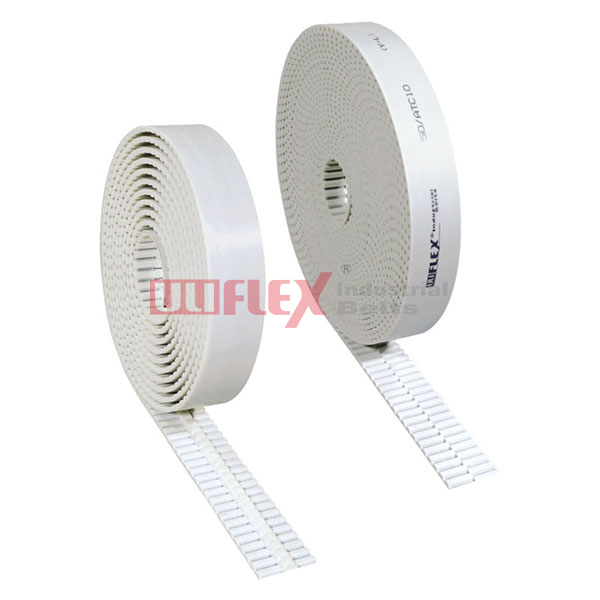
The manufacturing of these components relies on advanced extrusion technology. Engineers feed liquid thermoplastic polyurethane into a specialized extrusion die. They pull continuous tension cords through this same die simultaneously. The polyurethane cools and solidifies around the cords. This creates a uniform, continuous structure. Factories produce these belts in massive rolls. Equipment manufacturers can order exact custom lengths for long-span applications. You do not have to rely on standard fixed molds.
Thermoplastic Polyurethane (TPU) offers exceptional baseline characteristics. It delivers extremely high shear strength. This ensures the teeth do not tear away under sudden acceleration or deceleration. TPU boasts remarkable wear resistance. It glides over metallic pulleys with minimal friction. Most industrial variants feature a Shore A hardness rating of around 92. This specific hardness provides the perfect balance. It remains flexible enough to bend around pulleys without cracking. It stays rigid enough to maintain exact tooth shape under heavy loads.
A belt is only as strong as its core structure. Parallel tension members sit embedded deep within the polyurethane body. These longitudinal cords prevent the belt from stretching. They maintain the exact tooth pitch during heavy operational loads. If the pitch distorts, the teeth will not engage the pulley correctly. This leads to slipping and rapid wear. The embedded cords lock the dimensional stability in place permanently.
Continuous length availability: Ideal for large-scale gantry systems and long assembly lines.
High resistance to mechanical shear forces: Protects tooth integrity during rapid starts and stops.
Excellent dimensional stability: Maintains exact positioning over long operational periods.
Consistent tooth geometry: Ensures precise pulley engagement and reduces backlash.
Engineers frequently debate between polyurethane and rubber. Polyurethane wins decisively in specific environments. Cleanliness stands out as its primary advantage. Rubber belts shed fine black dust as they wear down over time. Polyurethane does not exhibit this shedding behavior. This clean operation proves crucial for food manufacturing. Medical device assembly and cleanroom manufacturing absolutely require this trait. You cannot risk contaminating a sterile product with floating rubber particles.
Polyurethane also offers superior chemical resistance. Industrial environments expose belts to various liquid hazards. Polyurethane resists lubricating oils and heavy greases effortlessly. It withstands exposure to many industrial solvents much better than standard neoprene. Furthermore, polyurethane allows for easy colorability. You can match the belt color to your machinery. You can implement color-coded maintenance systems across your entire facility.
We must also acknowledge where rubber wins. Rubber remains superior for extremely high-temperature environments. It dissipates heat highly efficiently. You should specify rubber for ultra-high-speed power transmission. Internal heat buildup destroys polyurethane at high rotational speeds. Rubber handles continuous, rapid flexing much better under these extreme thermal conditions.
Operational Constraint | Polyurethane Performance | Rubber Performance |
|---|---|---|
Cleanliness & Hygiene | Excellent (Zero black dust shedding) | Poor (Sheds carbon particles) |
Chemical & Oil Resistance | High (Resists greases and solvents) | Moderate (Degrades under certain oils) |
High-Speed Heat Dissipation | Low (Prone to internal heat buildup) | Excellent (Handles high RPMs well) |
Temperature Range | Standard (Up to ~80°C) | High (Can exceed 100°C) |
The tension member acts as the spine of the belt. It dictates the load-carrying capacity entirely. The cord also determines the overall resistance to elongation. You must select the internal material carefully.
A steel cord timing belt dominates high-precision tasks. It provides maximum tensile strength. It exhibits near-zero stretch under tension. This makes it ideal for exact linear positioning where millimeter accuracy matters. However, steel has clear drawbacks. It remains susceptible to corrosion. Moisture will degrade exposed steel ends rapidly. Steel also creates a very rigid belt structure. You must use larger minimum pulley diameters. Small pulleys will cause the steel cords to bend sharply, fatigue, and snap.
A Kevlar timing belt utilizes advanced aramid fibers. Kevlar is completely non-magnetic. It resists all forms of rust and corrosion. It offers incredible flexibility. You can route it around much smaller pulleys without causing internal damage. It also reduces the overall weight of the drive system. The main downside involves elongation. Kevlar exhibits slightly more stretch than steel when facing sudden peak loads.
Evaluate your environmental realities carefully. Use Kevlar in heavy washdown environments. Choose Kevlar when your machine design demands tight pulley radii. Select steel for dry environments where absolute positioning accuracy matters most. Always match the cord to the physical demands of your layout.
These specific components adapt to many different machine designs. A proper industrial timing belt handles complex automation tasks smoothly.
Linear motion systems rely heavily on their precise nature. Automated sliding doors use them for quiet, smooth operation. CNC machines require them to move heavy cutting heads with pinpoint accuracy. 3D printers use them to control complex X and Y axis movements flawlessly. Exact back-and-forth positioning defines these critical applications.
Synchronized conveying represents another massive use case. Modern assembly lines require precise product placement. The belt indexes products forward at exact intervals. Robotic arms can then interact with the moving products accurately. The teeth guarantee the belt will not slip out of phase.
Material handling automation utilizes open-ended belts for massive scale. Large gantries move heavy automotive parts across factory floors. Automated storage and retrieval systems depend on them to locate bins in massive warehouses. Packaging machinery uses them to feed cardboard and seal boxes continuously.
You must clearly understand their limitations. Open-ended belts face inherent structural boundaries. Even when technicians splice them into loops, they remain weaker than truly endless molded belts. We generally do not recommend them for high-torque, high-speed continuous power transmission. You cannot use them to run heavy rotational equipment. They will fail prematurely under continuous, heavy rotational stress.
Designing a customized timing belt involves several critical engineering decisions. You must look beyond standard off-the-shelf options.
You must understand splicing realities first. Technicians use advanced thermal welding to make an open-ended belt endless. They cut the ends into interlocking V-joint fingers. They apply precise heat and pressure. The polyurethane melts and fuses together permanently. Crucial implementation note: A spliced joint inherently holds only about 50% of the belt's original tensile strength. You must factor this structural reduction into your engineering calculations.
Backing materials add vital conveying properties. You can apply high-friction rubber to grip slippery products. You might bond soft polyurethane foam to convey delicate glass panels. Specific FDA-approved coatings exist for direct food transport. The right backing transforms a simple drive component into a specialized conveying surface.
Mechanical modifications solve unique product indexing problems. You can weld molded cleats directly to the back of the belt. These cleats push products securely up steep inclines. You can remove specific teeth to create false teeth inserts for custom attachments. You can even machine precision vacuum holes through the belt. This allows underlying suction to hold flat products firmly against the belt surface.
Advise your procurement team carefully regarding shortlisting logic. Identify manufacturers who offer in-house customization. This reduces overall lead times dramatically. It also limits stack-up tolerances. When multiple vendors modify a single part, small measurement errors compound. Keeping all modifications under one roof ensures much better quality control.
Sizing and pitch selection require absolute accuracy. You must match the belt pitch perfectly to the existing pulleys. Common metric profiles include T5, T10, AT5, and AT10. If the pitch mismatches even slightly, you will experience severe premature wear. The polyurethane teeth will grind against the metallic pulley flanges. This causes vibration and destroys system positioning accuracy completely.
Lead times dictate how you source your replacement materials. Buying standard continuous rolls offers significant operational advantages. You can purchase a 50-meter or 100-meter roll and keep it inside your facility. Your maintenance team can cut precise lengths on-site as needed. This eliminates shipping delays for emergency replacement parts. Alternatively, ordering pre-cut and spliced lengths saves immediate installation labor but requires exact initial measurements.
Evaluate your long-term operational efficiency carefully. A high-grade PU open ended timing belt carries a higher upfront cost than basic rubber options. However, you must weigh this against the systemic benefits. High-quality materials reduce maintenance downtime significantly. They provide much longer replacement cycles. You will perform fewer system recalibrations over the equipment's lifespan. The operational stability justifies the initial expenditure.
Watch out for these common engineering mistakes during rollout:
Ignoring the minimum pulley diameter requirements for stiff steel cords.
Failing to derate the maximum tensile strength for a thermally spliced joint.
Using standard polyurethane in environments frequently exceeding 80 degrees Celsius.
Matching an AT-profile belt with a standard T-profile pulley.
Selecting the correct linear motion component requires a highly balanced approach. You must align material properties with your exact operational loads. Evaluate your tension members based on required flexibility and expected moisture exposure. Always respect the tensile limits of thermally spliced joints in your engineering designs.
Take immediate action to improve your automated systems. Audit your current mechanical failure points today. Is your existing rubber belt shedding unacceptable black dust? Do you notice stretch and backlash in your linear actuators? Consult with an experienced application engineer to calculate precise load requirements. Request physical material samples to test chemical resistance inside your specific facility before executing a massive rollout.
A: We strongly advise against DIY splicing. Making a reliable V-joint requires specialized thermal welding equipment. You need precise temperature control and exact pressure application to fuse the polyurethane correctly. Improper DIY joints often fail prematurely, causing unexpected machine downtime and potential safety hazards. Always rely on factory-welded joints for structural integrity.
A: Manufacturers extrude these belts continuously. Standard rolls typically come in 50-meter or 100-meter lengths for easy shipping and handling. However, because the extrusion process is continuous, you can request custom production runs for much longer contiguous spans if your automated gantry system requires it.
A: Base your choice on moisture exposure. Standard steel provides excellent tensile strength for dry, indoor linear motion applications. If your machine operates in a high-humidity environment or requires frequent chemical washdowns, you must upgrade to stainless steel cords to prevent internal rust and premature cord failure.
A: Standard industrial polyurethane is not inherently food-safe. However, manufacturers produce specific FDA and EU-compliant grades. These specialized belts use safe raw materials and feature antimicrobial properties. Always request specific food-grade certification documentation before installing any belt in direct contact with consumable goods.